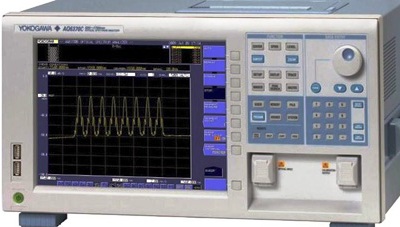
YOKOGAWA AQ6370C CALIBRATION and YOKOGAWA AQ6370C REPAIR

 
A calibration by Custom-Cal is performed by engineers with extensive OEM experience. We have the expertise and the necessary standards to perform the YOKOGAWA AQ6370C Calibration, onsite calibration may be available. We specialize in quick turnaround times and we can handle expedited deliveries upon request.

Need another Optical Spectrum Analyzer, OSA?
Shop for Comparable Products on our
 used Optical Spectrum Analyzer, OSA page or new Optical Spectrum Analyzer, OSA page

As an alternative New Ridge Technologies offers the NRT-8000, the world’s Smallest Optical Spectrum Analyzer with built in “live wavelength calibration” for C-Band applications.  More
   YOKOGAWA AQ6370C   Description / Specification:    
YOKOGAWA AQ6370C 600 to 1700 nm Optical Spectrum Analyzer

The Yokogawa AQ6370C Optical Spectrum Analyzer uses an advanced monochromator that achieves high wavelength resolution and high close-in dynamic range. With the sharper spectral characteristics of the monochromator, spectral signals in close proximity can be separated clearly and measured accurately. Measure a pulse peak spectrum of a pulsed light signal. Often used in the transmission loop testing of telecommunication systems, and also in the low power measurement at the early stage of laser chip development to catch the peak power of a pulsed signal. The AQ6370C’s wide close-in dynamic range allows accurate OSNR measurement of DWDM transmission systems. The built-in WDM analysis function analyzes the measured waveform and shows peak wavelength, peak level and OSNR of WDM signals up to 1024 channels simultaneously. The curve fit function is used to accurately measure noise levels. Specifications. Wavelength range: 600 to 1700 nm. Span. 0.5 nm to 1100 nm (full span), and 0 nm. Wavelength accuracy: ±0.10 nm (Full range). Wavelength linearity: ±0.01 nm (1520 to 1580 nm), ±0.02 nm (1450 to 1520 nm, 1580 to 1620 nm). Wavelength repeatability: ±0.005 nm (1 min.). Wavelength resolution setting: 0.02, 0.05, 0.1, 0.2, 0.5, 1 and 2 nm. Wavelength resolution accuracy: ±5% (1450 to 1620 nm, Resolution setting: = 0.1 nm, Resolution correction: ON, Number of sampling: AUTO). Min. sampling resolution: 0.001 nm. Number of sampling: 101 to 50001, AUTO. Level sensitivity setting: NORM_HOLD, NORM_AUTO, NORMAL, MID, HIGH1, HIGH2 and HIGH3. High dynamic mode: SWITCH (Sensitivity: MID, HIGH1-3). Level sensitivity: -90 dBm (1300 to 1620 nm), -85 dBm (1000 to 1300 nm), -60 dBm (600 to 1000 nm) (Sensitivity: HIGH3). Maximum input power: +20 dBm (Per channel, full range). Level accuracy: ±0.4 dB (1310/1550 nm, Input level: -20 dBm, Sensitivity: MID, HIGH1-3). Level linearity: ±0.05 dB (Input level: -50 to +10 dBm, Sensitivity: HIGH1-3). Level flatness: ±0.1 dB (1520 to 1580 nm), ±0.2 dB (1450 to 1520 nm, 1580 to 1620 nm). Polarization dependence: ±0.05 dB (1550/1600 nm), ±0.08 dB (1310 nm). Stray-light suppression ratio: 73 dB. Optical return loss: Typ. 35 dB (with angled-PC connector). Spec codes; 10: Standard model, 20: High performance model.


Looking for a replacement? Try the  DEVISER AE8600

Standard Calibration $1,065.00 *
Click on Logo for More Prices
*This is a Web introductory price for one calibration of the YOKOGAWA AQ6370C. Price does not in most cases include measurement performance data. Pricing does include NIST traceable calibration and issue of a calibration certificate and calibration label. Pricing may vary slightly due to volume and location of laboratory supporting calibration. Volume pricing may apply. On-site fees may apply depending on logistics, location and volume of work to be completed during the visit.


Related Optical Terms and Definitions. For a complete list go to our  Terms and Definitions Page.

Chromatic Dispersion
Chromatic Dispersion is a broadening of the input signal as it travels down the length of the fiber. Chromatic Dispersion results from a variation in propagation delay with wavelength, and is affected by fiber materials and dimensions.

Detector
A Detector is a signal conversion device that converts power from one form to another, such as from optical power to electrical power

Jitter
Jitter in technical terms is the deviation in or displacement of some aspect of the pulses in a high-frequency digital signal. Jitter is the time variation of a periodic signal in electronics and telecommunications, often in relation to a reference clock source. Jitter may be observed in characteristics such as the frequency of successive pulses, the signal amplitude, or phase of periodic signals. Jitter is a significant, and usually undesired, factor in the design of almost all communications links (e.g., USB, PCI-e, SATA, OC-48). In clock recovery applications it is called timing jitter.

Polarization Mode Dispersion (PMD)
Polarization mode dispersion (PMD) is a form of modal dispersion where two different polarizations of light in a waveguide, which normally travel at the same speed, travel at different speeds due to random imperfections and asymmetries, causing random spreading of optical pulses. It is he difference between the maximum and minimum values of loss typically measured in ps/km^1/2.


Please contact us for your YOKOGAWA AQ6370C CALIBRATION and/or YOKOGAWA AQ6370C 600 to 1700 nm Optical Spectrum Analyzer REPAIR

I'm interested in: 
Calibration Type (Select one):
Repair Information:
 Serial Number:

 Is there any physical damage?  
 If yes, describe:


What is the description of the problem?

How/when did the problem start?


 (*) Required Fields    For formal quote please fill in all fields.
Company:
From (Email):*
Contact Name:*
Country:*
Address 1:
Address 2:
City:
State/Territory/Province: *
Zip/Postal Code:
Phone:*

Comment: