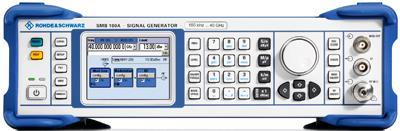
ROHDE & SCHWARZ SMB100A CALIBRATION and ROHDE & SCHWARZ SMB100A REPAIR

 
A calibration by Custom-Cal is performed by engineers with extensive OEM experience. We have the expertise and the necessary standards to perform the ROHDE & SCHWARZ SMB100A Calibration, onsite calibration may be available. We specialize in quick turnaround times and we can handle expedited deliveries upon request.

Need another Signal Generator?
Shop for Comparable Products on our
 used Signal Generator page

 
   ROHDE & SCHWARZ SMB100A (1406.6000.02)   Description / Specification:   Spec Sheet 
ROHDE & SCHWARZ SMB100A RF Signal Generator Series

The R&S SMB100A series signal generators have a frequency range up to 40 GHz that provides outstanding spectral purity and high output power. In addition to pure CW signals, the R&S®SMB100A also provides the most common analog AM and FM/fM modulation modes as standard. Moreover, the R&S®SMB100A can be equipped with an excellent pulse generator and pulse modulator that makes it possible to generate user-programmable pulse scenarios, also referred to as pulse trains. Key facts. Excellent signal characteristics with low SSB phase noise of typ. -128 dBc (at 1 GHz, 20 kHz offset). High output power of typ. up to +27 dBm. Analog modulations with AM, FM/fM and pulse modulation supported. Frequency extension from 50 GHz to 110 GHz in combination with the R&S®SMZ frequency multiplier. Support of R&S®NRP-Zxx power sensors. Remote control via LAN, USB and GPIB including emulation modes for legacy instruments. 
Specifications

Frequency.
Frequency range: 9 kHz up to 40 GHz.
Setting time: SCPI mode < 3 ms, List mode < 1 ms. 

Level.
Maximum specified output power (PEP): up to +19 dBm (1 MHz < f <= 1.1 GHz).
Minimum specified output power: down to - 120 dBm.
Setting time (without switching of the mechanical attenuator): SCPI mode < 2.5 ms, List mode < 1 ms.

Spectral purity.
SSB phase noise, f = 1 GHz, carrier offset = 20 kHz, 1 Hz measurement bandwidth: < -122 dBc, typ. -128 dBc. 
Harmonics. 1 MHz < f <= 1.1 GHz; level <= 13 dBm), f > 1.1 GHz; level <= 10 dBm): < -30 dBc. 

Supported modulation modes.
AM: standard.
AM depth: 0 % to 100 %.
FM/fM: standard.
Maximum FM deviation f = 10 GHz: 32 MHz.
Maximum fM deviation f = 10 GHz: 320 rad.
Pulse: R&S®SMB-K21/-K22 pulse modulator.
Rise/fall time: < 20 ns, typ. < 5 ns.
ON/OFF ratio: > 80 dB.
Minimum pulse width of pulse generator output: 10 ns. 

Options.
SMB-B101 - 9 kHz to 1.1 GHz.
SMB-B102 - 9 kHz to 2.2 GHz.
SMB-B103 - 9 kHz to 3.2 GHz.
SMB-B106 - 9 kHz to 6 GHz.
SMB-B112 - 100 kHz to 12.75 GHz, with electronic step attenuator.
SMB-B112L - 100 kHz to 12.75 GHz, without step attenuator.
SMB-B120 - 100 kHz to 20 GHz, with mechanical step attenuator.
SMB-B120L - 100 kHz to 20 GHz, without step attenuator.
SMB-B131 - 100 kHz to 31.8 GHz, with mechanical step attenuator.
SMB-B140 - 100 kHz to 40 GHz, with mechanical step attenuator.
SMB-B140L - 100 kHz to 40 GHz, without step attenuator.
SMB-B140N - 100 kHz to 40 GHz, with mechanical step attenuator, minimum pulse width limited.
SMB-B1 - OCXO Reference Oscillator.
SMB-B1H - OCXO Reference Oscillator, high performance.
SMB-B5 - Stereo/RDS Coder.
SMB-K22 - Pulse Modulator.
SMB-K23 - Pulse Generator.
SMB-K27 - Pulse Train.


Standard Calibration $920.00 *
Click on Logo for More Prices
*This is a Web introductory price for one calibration of the ROHDE & SCHWARZ SMB100A. Price does not in most cases include measurement performance data. Pricing does include NIST traceable calibration and issue of a calibration certificate and calibration label. Pricing may vary slightly due to volume and location of laboratory supporting calibration. Volume pricing may apply. On-site fees may apply depending on logistics, location and volume of work to be completed during the visit.


Related Bench Equipment Terms and Definitions. For a complete list go to our  Terms and Definitions Page.

Channel Bandwidth
Channel Bandwidth is the bandwidth over which power is measured. This is usually the bandwidth in which almost all of the power of a signal is contained.

Jitter
Jitter in technical terms is the deviation in or displacement of some aspect of the pulses in a high-frequency digital signal. Jitter is the time variation of a periodic signal in electronics and telecommunications, often in relation to a reference clock source. Jitter may be observed in characteristics such as the frequency of successive pulses, the signal amplitude, or phase of periodic signals. Jitter is a significant, and usually undesired, factor in the design of almost all communications links (e.g., USB, PCI-e, SATA, OC-48). In clock recovery applications it is called timing jitter.

Overshoot
Overshoot is the distortion that follows a major transition; the difference between the peak power point and the pulse-top amplitude computed as a percentage of the pulse-top amplitude.

Rise Time
Rise time refers to the time required for a signal to change from a specified low value to a specified high value, usually 10 and 90 percent of pulse-top amplitude (vertical display is linear power).


Please contact us for your ROHDE & SCHWARZ SMB100A CALIBRATION and/or ROHDE & SCHWARZ SMB100A RF Signal Generator Series REPAIR

I'm interested in: 
Calibration Type (Select one):
Repair Information:
 Serial Number:

 Is there any physical damage?  
 If yes, describe:


What is the description of the problem?

How/when did the problem start?


 (*) Required Fields    For formal quote please fill in all fields.
Company:
From (Email):*
Contact Name:*
Country:*
Address 1:
Address 2:
City:
State/Territory/Province: *
Zip/Postal Code:
Phone:*

Comment: