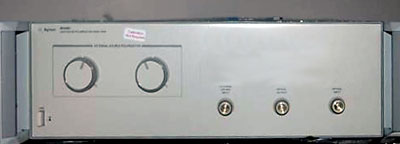
Keysight (Agilent) 8509C CALIBRATION and Keysight (Agilent) 8509C REPAIR

The Keysight (Agilent) 8509C is currently in stock and available for purchase on our  Sales Page
It is also available for immediate rental.
A calibration by Custom-Cal is performed by engineers with extensive OEM experience. We have the expertise and the necessary standards to perform the Keysight (Agilent) 8509C Calibration, onsite calibration may be available. We specialize in quick turnaround times and we can handle expedited deliveries upon request.

Need another Polarization Meter?
Shop for Comparable Products on our
 used Polarization Meter page or new Polarization Meter page

 
   Keysight (Agilent) 8509C   Description / Specification:    
Keysight (Agilent) 8509C Lightwave Polarization Analyzer

The Agilent 8509C lightwave polarization analyzer offers high-speed, calibrated polarization measurements of both optical signals and components. Measurement capabilities include; Polarization Mode Dispersion (PMD), Polarization Dependent Loss (PDL), Polarization Maintaining Fiber (PMF) launch alignment (polarization cross talk), Degree of Polarization (DOP), Stokes Parameters and Average power measurements.

Wide wavelength range: 1280-1640 nm S, C and L band coverage.
Polarization mode dispersion accuracy: ±0.05ps (50fs).
Polarization mode dispersion measurement range: 0.01 ps (10 fs) to 400 ps, measure very low PMD using the highly accurate Jones Matrix Eigenanalysis (JME) method. PMD measurements can also be made using the Fixed Analyzer (or wavelength scanning) method.
Wide dynamic range: +10 dBm to -55 dBm.
High-speed measurements: Polarization measurement rate of > 3500 points per second.

Receiver Characteristics.
Wavelength operating range: 1280nm to 1640nm.
PMD measurement range: <0.01 ps (10 fs) to 400 ps (depends on setup conditions).
Input power operating range: +10 dBm to -55 dBm.
Input average power damage level: +16 dBm.
Average power measurement linearity: ±0.06 dB.
Average power measurement uncertainty: ±15%.
Degree of polarization measurement;
  1280 nm to 1340 nm ±2.0%,
  1470 nm to 1580 nm ±2.0%,
  1580 nm to 1630 nm ±3.0%,
  1630 nm to 1640 nm ±5.0%.
Polarization state measurement rate: >3500 per second.
Polarization state display update rate: >3500 per second.
Return loss: -50 dB.


Standard Calibration $1,440.00 *
Click on Logo for More Prices
*This is a Web introductory price for one calibration of the Keysight (Agilent) 8509C. Price does not in most cases include measurement performance data. Pricing does include NIST traceable calibration and issue of a calibration certificate and calibration label. Pricing may vary slightly due to volume and location of laboratory supporting calibration. Volume pricing may apply. On-site fees may apply depending on logistics, location and volume of work to be completed during the visit.


Related Optical Terms and Definitions. For a complete list go to our  Terms and Definitions Page.

Bandwidth
Bandwidth is the difference between the upper and lower frequencies in a contiguous set of frequencies within which a fiber optic component, link or network will operate.

Extinction Ratio (ER)
Extinction Ratio is the ratio of two optical power levels, of a digital signal generated by an optical source, (example a laser diode), where P1 is the optical power level generated when the light source is "on," and P0 is the power level generated when the light source is "off." The extinction ratio may be expressed as a fraction, in dB, or as a percentage.

Optical Signal-to-noise Ratio (OSNR)
Optical Signal-to-noise ratio is the ratio between the signal power and the noise power in a given bandwidth. Most commonly a reference bandwidth of 0.1 nm is used. This bandwidth is independent from the modulation format, the frequency and the receiver. For instance a OSNR of 20dB/0.1nm could be given, even the signal of 40 GBit DPSK would not fit in this bandwidth. OSNR is measured with a Optical Spectrum Analyzer. It is generally measured at the wavelength of interest.

Repeatability
Repeatability is the variation in a number of repeated measured quantities when measurement conditions are changed and restored. The value corresponds to half the spread between the minimum and maximum value measured.

Wavelength Repeatability
Wavelength Repeatability is the random uncertainty in reproducing a wavelength after detuning and re-setting the wavelength. The wavelength repeatability is ± half the span between the maximum and the minimum value of all actual values of these wavelengths. Example test condition: uninterrupted TLS output power, constant power level, temperature within operating temperature range, coherence control off, short time span. Note: NOTE The long-term wavelength repeatability can be obtained by taken the wavelength repeatability and wavelength stability into account.


Please contact us for your Keysight (Agilent) 8509C CALIBRATION and/or Keysight (Agilent) 8509C Lightwave Polarization Analyzer REPAIR

I'm interested in: 
Calibration Type (Select one):
Repair Information:
 Serial Number:

 Is there any physical damage?  
 If yes, describe:


What is the description of the problem?

How/when did the problem start?


 (*) Required Fields    For formal quote please fill in all fields.
Company:
From (Email):*
Contact Name:*
Country:*
Address 1:
Address 2:
City:
State/Territory/Province: *
Zip/Postal Code:
Phone:*

Comment: